
Determining Liability in Major Truck Accidents: A Comprehensive Guide
Key Takeaways
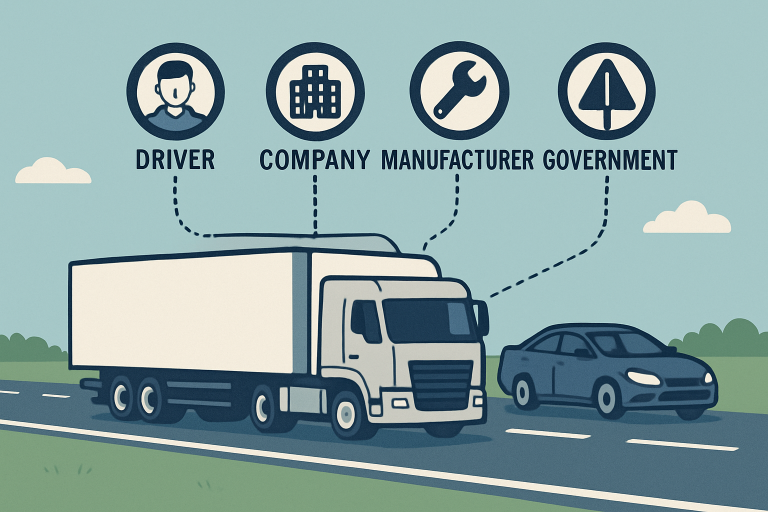
- Liability in truck accidents is multi-layered and often involves drivers, trucking companies, parts manufacturers, and government entities.
- A comprehensive investigation is crucial to identify all responsible parties.
- Legal definitions of fault impact the distribution of financial responsibility and compensation for victims.
Table of Contents
- Driver Responsibility
- Trucking Company Liability
- Vehicle and Parts Manufacturers
- Government Entities
- Legal Frameworks and Comparative Fault
- Real-World Examples
- Steps to Take After a Truck Accident
- Conclusion
Major truck accidents pose serious risks to everyone on the road, resulting in life-altering injuries, significant property loss, or even tragic fatalities. Establishing who is liable in these incidents is a critical first step for those seeking justice and fair compensation. Whether you are a driver, a pedestrian, or a passenger impacted by a truck crash, unraveling the complexities of liability can determine the outcome of your case. To understand more about your legal recourse following a truck accident in Texas, consider consulting with a Truck Accident Lawyer in TX who specializes in these matters.
The challenge in major truck collisions is that multiple parties may share responsibility. Factors like driver negligence, improper vehicle maintenance, defective parts, or unsafe road conditions can all play a role. Knowing how liability is determined and who can be held accountable helps victims and their families navigate the aftermath of a tragic event, protecting their rights and interests.
The legal process starts with a comprehensive investigation of the circumstances that caused the crash. This investigation may involve examining the driver’s qualifications, maintenance logs, road conditions, and safety records of the companies involved. Identifying what went wrong is fundamental, as it influences who can be named in a claim and the amount of compensation available.
Modern legal frameworks further complicate liability in truck accidents, as different states and countries may apply unique rules for assigning fault and awarding damages. Understanding these systems, such as comparative fault rules, is essential for anyone affected by a serious truck crash.
Driver Responsibility
Truck drivers are often scrutinized first in the wake of a serious accident. Common causes linked to driver liability include fatigue, distracted driving, substance impairment, excessive speed, and ignoring traffic signals. For example, the 2020 Eastern Freeway truck crash in Australia tragically demonstrated how driving under the influence led to a deadly result, claiming the lives of four police officers. The incident drew national attention to the importance of regular drug testing and monitoring in the trucking industry. More information on the investigation and findings can be found in this CNN report on the crash.
Driver responsibility also extends to proper rest and compliance with hours-of-service regulations, which are designed to prevent fatigue-related accidents. Even a momentary lapse in judgment behind the wheel of a large truck can cause devastating harm due to the sheer size and momentum of these vehicles.
Trucking Company Liability
Trucking companies are required by law to employ only qualified drivers, provide ongoing training, maintain their fleets, and ensure compliance with both federal and state safety guidelines. When companies pressure drivers to meet unrealistic schedules or cut corners on safety protocols, they expose themselves to liability. For example, if a company fails to complete routine inspections and a component failure contributes to an accident, the company can be named in a negligence lawsuit. Often, company records, including driver logs and maintenance documents, become pivotal evidence in these cases.
Vehicle and Parts Manufacturers
Not all truck accidents are caused by human error. Faulty components or poor design can also lead to catastrophic results. Defective brake systems, tire blowouts, steering failures, and even software malfunctions have all been implicated in past disasters. The 2019 Lakewood semi-truck crash in Colorado is one example in which brake failure played a central role, illustrating the legal concepts of product liability. Manufacturers can be held responsible for providing compensation if it is proven that a defect directly contributed to the incident. The National Highway Traffic Safety Administration regularly publishes data on automotive recalls and defects, highlighting the ongoing importance of this area of law.
Government Entities
Poor infrastructure, unclear signage, and unrepaired road hazards sometimes cause or worsen truck crashes. In such instances, local, state, or federal agencies may be liable for failing to maintain safe roads. Suing a government body typically involves following unique legal procedures and strict timelines, which can make these claims more complicated than those against private entities. However, if systematic neglect or hazardous conditions contributed directly to the accident, victims can seek damages for their losses. Articles such as this New York Times overview discuss the growing spotlight on infrastructure safety nationwide.
Legal Frameworks and Comparative Fault
Legal rules for assigning liability vary by state or country where the crash occurs. In the United States, many states use comparative fault systems, in which multiple parties, including the victim, can share responsibility. In Michigan, for instance, victims can still receive compensation even if their share of fault is less than 50 percent, but the compensation is reduced proportionally to their degree of responsibility. If the victim’s share is more than half, they lose the right to recover non-economic damages. These nuanced differences can significantly affect case outcomes, so understanding your jurisdiction’s specific legal framework is key. More on different comparative fault models is available on FindLaw.
Real-World Examples
- Memphis Tanker Truck Disaster (1988): This accident involved a tanker truck explosion that killed nine and led to significant property damage. The fact that the truck passed inspection shortly before the incident drew attention to possible gaps in safety protocols and regulatory oversight.
- Humboldt Broncos Bus Crash (2018): A collision between a bus carrying a junior ice hockey team and a semi-truck brought international focus to the issue of driver responsibility, as the truck operator faced charges of dangerous driving causing death and injury.
Steps to Take After a Truck Accident
- Ensure Safety: Move to a secure area if you can and check yourself and others for injuries.
- Contact Emergency Services: Inform the police and request medical attention immediately.
- Document the Scene: Take photographs, collect witness statements, and note any relevant details like road conditions or weather.
- Seek Medical Assessment: Always have a medical professional evaluate you, as some injuries may not be immediately apparent.
- Consult with Legal Counsel: A lawyer experienced in truck accidents can help clarify your rights and lead an independent investigation to secure necessary evidence.
Conclusion
Determining liability in major truck accidents is an in-depth process involving careful examination of the people, vehicles, and environment involved. Whether it is driver negligence, faulty equipment, corporate misconduct, or poor infrastructure, any factors should be thoroughly reviewed to ensure justice for victims. Understanding the unique rules and potential responsible parties is crucial for securing rightful compensation after a serious accident.